WOWSMM Blog

Insights, Guides & Updates

Everything about SMM panels, social media growth & marketing tips — practical guides, honest comparisons and the latest WowSMM feature updates.

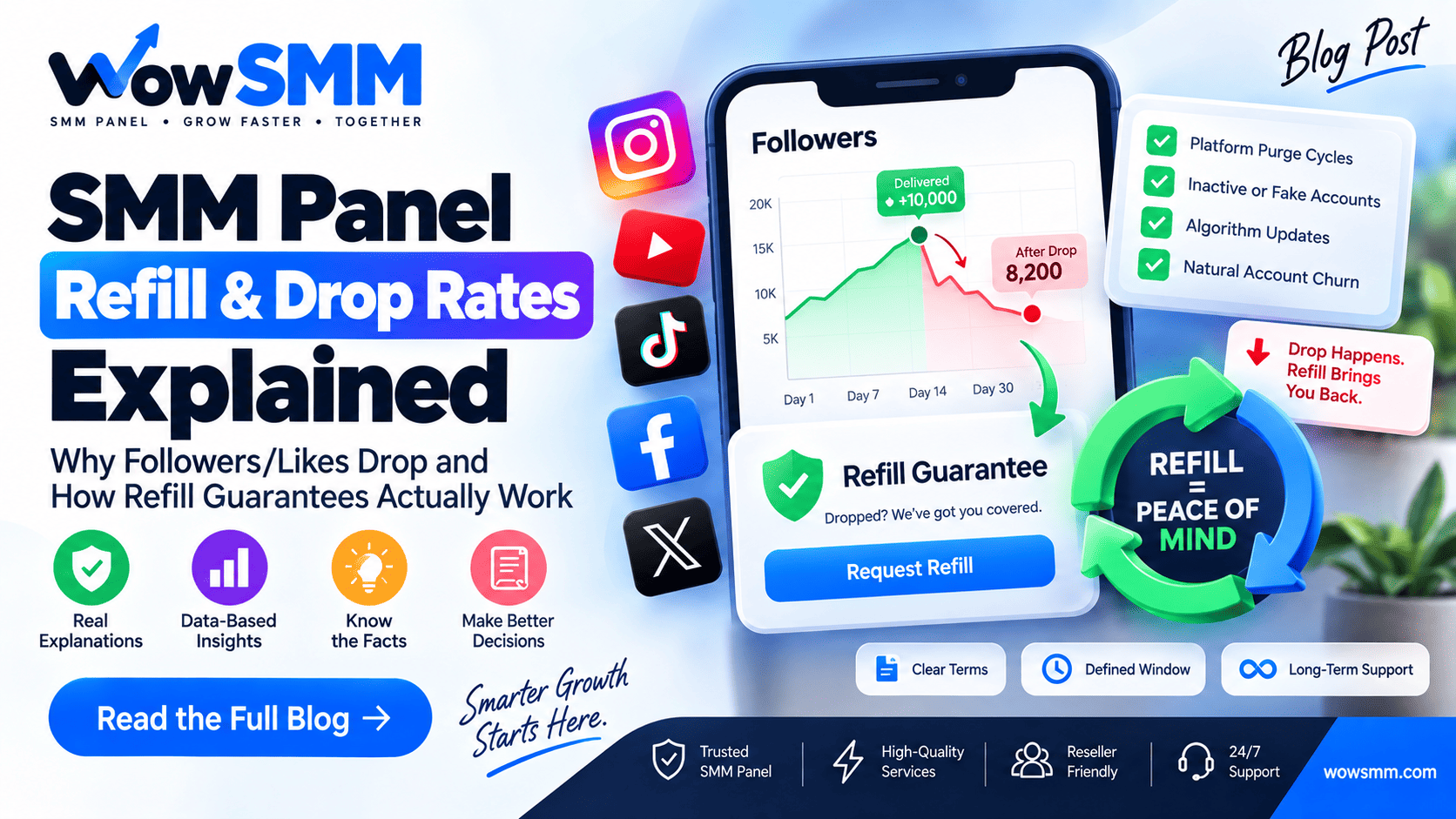
SMM Panel Refill & Drop Rates Explained: Why Followers/Likes Drop and How Refill Guarantees Actually Work

SMM Panel Refill & Drop Rates Explained: Why Followers/Likes Drop and How Refill Guarantees Actually Work

SMM Panel Refill & Drop Rates Explained: Why Followers/Likes Drop and How Refill Guarantees Actually Work

Followers, likes, and views "drop" because platforms continuously run cleanup sweeps that remove low-quality, inactive, or policy-violating accounts — including the exact accounts that delivered your order — and a refill guarantee simply replaces whatever was removed, within a set time window, at no extra cost. Here's the full mechanic: why drops happen, how refill windows actually work, and how to read a provider's refill policy like someone who's seen the order data.

Why Drops Happen in the First Place

Drop isn't a sign that something went wrong with your specific order — it's a structural feature of how social platforms operate:

  • Platform purge cycles. Instagram, YouTube, TikTok and others periodically run large-scale sweeps that remove accounts violating authenticity policies — fake accounts, spam accounts, and bot-like accounts get removed in batches, sometimes affecting millions of accounts platform-wide in a single cycle. If any of the accounts that engaged with your content get caught in one of these sweeps, your count drops accordingly.
  • Natural account churn. Some portion of any large account pool — real or otherwise — goes inactive, gets deleted by its owner, or gets suspended for unrelated reasons over time. This happens even to organic followers; purchased engagement just makes the effect more visible because it arrived all at once.
  • Algorithm and policy updates. When a platform updates its spam-detection model, accounts that passed under the old model can suddenly get flagged under the new one — causing a wave of drops across many panels and providers at once, unrelated to any single order's quality.

None of this means drop is unlimited or unpredictable forever — it's why refill windows exist as a defined, bounded commitment rather than an open-ended promise.

The Refill Formula (How It's Actually Calculated)

Refill eligibility is calculated with a simple formula:

Start Count + Quantity Ordered = Expected End Count

If your current count falls below the Expected End Count while you're still inside the refill window, the shortfall is eligible for a free top-up. For example: if your Start Count was 1,000 and you ordered 500, your Expected End Count is 1,500. If you check back in three weeks and the count reads 1,350, you're eligible for a refill of 150 — not a refund, a top-up back toward 1,500.

Two things commonly void this eligibility even inside the refill window: switching the account or post to private (the system can no longer verify the current count), and changing the username on an order that was tied to that username rather than a fixed post URL.

Comparing Refill Windows

WindowWhat it meansTypical use case
No refill / 0 daysCheapest tier — no top-up coverage at all after delivery.One-off views or engagement where longevity doesn't matter.
24–30 daysCovers the highest-drop early period right after delivery, when platform sweeps are most likely to catch recently-added engagement.Budget-conscious orders on stable accounts.
60–90 daysExtends coverage through several typical purge cycles.Balanced option for accounts you plan to keep active.
365 daysA full year of coverage — meaningfully reduces the chance you'll ever see an uncovered drop.Business/brand accounts where consistent numbers matter long-term.
LifetimeOngoing coverage for as long as the service remains active on the panel's end.Highest-cost tier, for accounts where any visible drop is unacceptable.

Longer windows cost more because the panel is committing provider resources to monitor and top up that order for longer — it's a real ongoing cost, not just a marketing label.

What "Non-Drop" Actually Promises (and Doesn't)

A "non-drop" or "real-looking" service typically sources engagement from higher-quality accounts — ones with profile pictures, post history, and activity patterns that make them less likely to be swept in a purge cycle. That translates to a statistically lower drop rate, not a guarantee of zero drop. No provider — regardless of what the listing says — can honestly promise permanent, absolute zero drop forever, because platform enforcement decisions aren't something any panel or provider controls. Treat "non-drop" as a quality and refill-confidence tier, and rely on the stated refill window as the actual enforceable commitment.

How to Read a Provider's Refill Policy (Red Flags vs. Fair Terms)

  • Fair: A clearly stated window (e.g., "30 Days Refill") with a simple, documented way to request it (a Refill button or ticket) and clear exclusions (private accounts, username changes).
  • Red flag: Vague language like "we may refill at our discretion" with no stated window — this isn't a real guarantee, it's a courtesy that can be denied at any time.
  • Red flag: A "lifetime" claim with no exclusions listed at all — every honest lifetime policy still excludes private/deleted accounts, because there's no way to verify a count that can no longer be checked.
  • Fair: Refill calculated against your actual Start Count (verifiable, recorded automatically) rather than a vague "we'll top it up if it looks low" judgment call.

Frequently Asked Questions

How do I request a refill?

On WowSMM, use the Refill option on your order from the Orders page while the order is still inside its refill window. Keep the order ID handy — refill is tied to the specific order and link, not to the account generally.

Will refill work if I made my account private?

No. If the account or post is private (or deleted), the system can't verify the current count, so refill eligibility is voided for that order until it's public again — and even then, only within the original window.

Does a higher price always mean a longer refill window?

Usually, yes — refill window length is one of the main drivers of price differences between otherwise-similar services for the same platform and quantity.

Can I get a refund instead of a refill if my count drops?

Typically no — refill replaces the missing quantity rather than refunding money, since the order was genuinely delivered at the time; refunds are a separate policy that applies to partial or failed deliveries, not to later drops.

See the exact refill and refund terms for your order type on our FAQ page, or browse refill windows by service on the services page.

Ready to start? See our Spotify SMM panel for services, delivery details and FAQs.
Read More SMM Panel Refill & Drop Rates Explained: Why Followers/Likes Drop and How Refill Guarantees Actually Work

Is Buying Followers Safe in 2026? A Platform-by-Platform Breakdown of Ban & Shadowban Risk

Is Buying Followers Safe in 2026? A Platform-by-Platform Breakdown of Ban & Shadowban Risk

Is Buying Followers Safe in 2026? A Platform-by-Platform Breakdown of Ban & Shadowban Risk

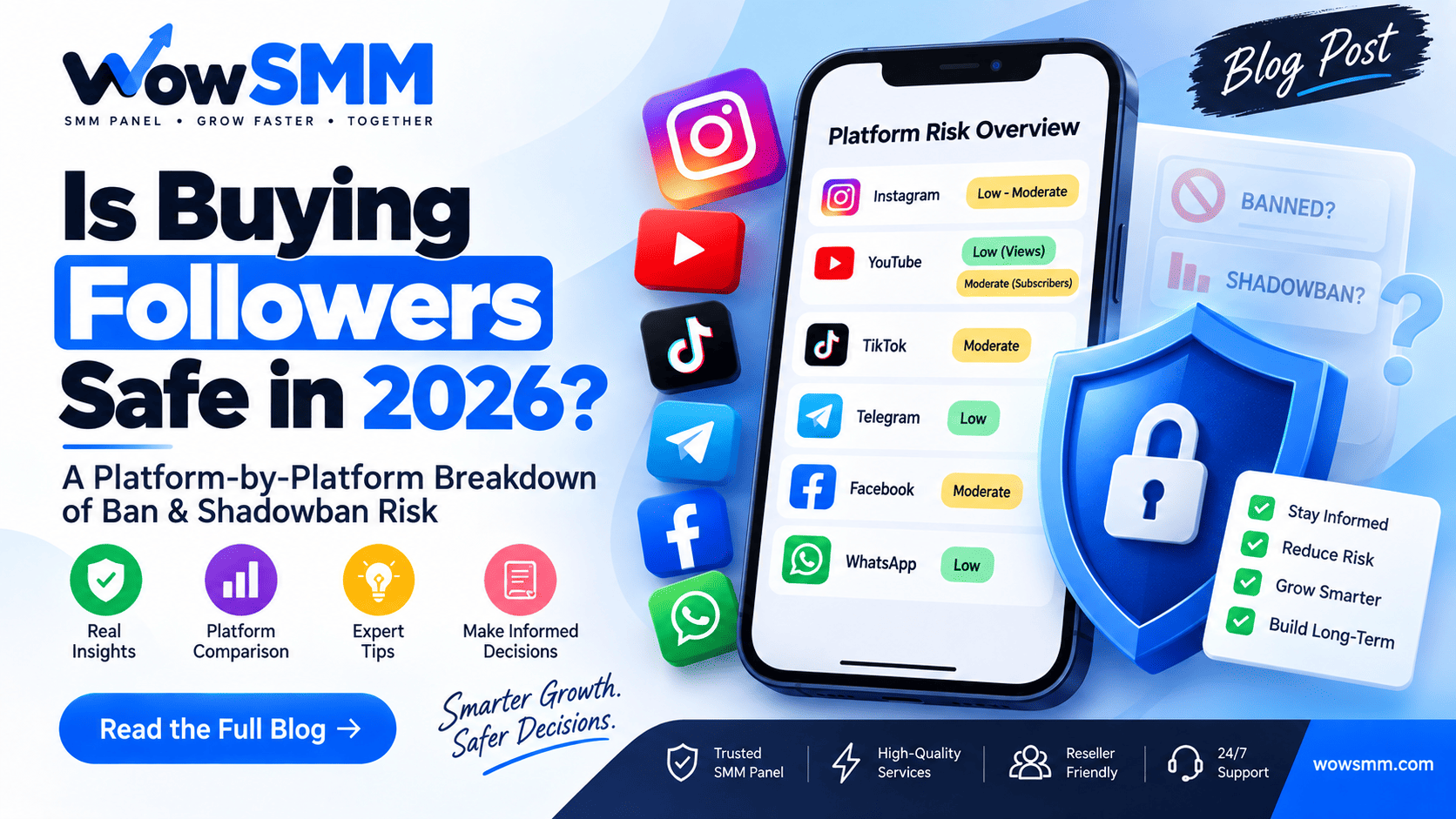
Buying followers, likes, or views does not automatically get an account banned — the actual risk comes from how the order is delivered (sudden spikes, obviously fake accounts, third-party login access) rather than from the act of buying itself. Risk levels differ meaningfully by platform, by delivery method, and by whether the growth looks proportional to your account's existing activity. Below is a realistic, platform-by-platform breakdown instead of a generic "yes/no."

What Actually Triggers Enforcement (Across All Platforms)

Platforms don't have a magic detector for "this follower was purchased." What they detect are patterns that correlate with inorganic growth:

  • Sudden, disproportionate spikes — 10,000 new followers overnight on an account that normally gains 20 a day stands out far more than the same 10,000 spread across three weeks.
  • Low-quality or clustered accounts — engagement from accounts with no profile picture, no posts, or created in the same batch is easier for automated systems to sweep in bulk purges.
  • Third-party login access — services that ask for your username and password (rather than just your public link or user ID) carry a separate, much higher risk: account takeover, unauthorized posting, or a permanent suspension for credential sharing. Order-by-link/ID services (the standard SMM panel model) don't need your password and don't carry this risk.
  • Stacking identical orders across multiple panels at once — beyond voiding refund eligibility on most panels, this also compounds the spike pattern above.

Instagram

Risk tier: Low-to-Moderate, mainly for follower/like spikes; higher for automated engagement pods. Instagram's spam systems are tuned to detect rapid follower spikes and bot-like engagement ratios (very high likes relative to followers, or likes from accounts with zero mutual interest signals). Views and non-interactive metrics (reach, plays) are lower-risk since they don't create as visible a public pattern. Drip-fed, gradual delivery meaningfully reduces exposure versus an instant, all-at-once order. Enforcement typically shows up as reduced reach ("shadowban") rather than an outright ban for moderate purchases; outright suspensions are more associated with combining purchased engagement with automation tools (auto-follow/unfollow bots, engagement pods) on the same account.

YouTube

Risk tier: Low for views, Moderate for subscribers. YouTube's system is relatively tolerant of view-count purchases because views are the platform's own ad-revenue metric and get heavy automated filtering rather than manual enforcement — inflated or invalid views are typically just quietly not counted, with no account penalty in most cases. Subscriber purchases carry more risk because subscriber count feeds directly into monetization eligibility (the Partner Program threshold), so YouTube scrutinizes suspicious subscriber patterns more closely, especially sudden spikes uncorrelated with any video's actual performance.

TikTok

Risk tier: Moderate. TikTok's recommendation and spam-detection systems are newer and more aggressive than Instagram's in some respects, and the platform actively deprioritizes (rather than bans) accounts it flags as inauthentic — meaning the more common consequence is reduced For You Page distribution rather than suspension. Follower and like purchases on very new accounts (under a few weeks old) are scrutinized more than the same purchase on an established account with a normal posting history.

Telegram

Risk tier: Low. Telegram has comparatively limited automated anti-spam enforcement on channel member counts, and purchased channel members/views rarely trigger any account-level action. The main practical risk isn't a ban — it's that a channel with a large member count but near-zero real engagement is obvious to human visitors, which hurts credibility rather than triggering a platform penalty.

Facebook

Risk tier: Moderate. Facebook's enforcement is generally similar to Instagram (both are Meta products sharing detection infrastructure) but tends to focus more on Page-level authenticity signals — sudden Page like spikes from accounts with no other Facebook activity are a known red flag pattern in Meta's spam systems.

WhatsApp

Risk tier: Low, with a narrow but serious exception. Purchased Channel followers/reactions on WhatsApp Channels carry low risk since WhatsApp doesn't run the same kind of engagement-authenticity detection as Instagram or TikTok. The exception: WhatsApp is far stricter about bulk/automated messaging behavior (not about follower counts) — mass-messaging tools can get a number banned, which is a completely separate risk from buying Channel engagement.

Practical Ways to Reduce Risk (Any Platform)

  1. Use drip-feed delivery instead of instant, especially for larger orders — spreading 10,000 followers over several days looks far more organic than an overnight spike.
  2. Match order size to account activity. A brand-new account with 3 posts jumping to 50,000 followers is a bigger red flag than an active account with a consistent posting history growing by the same amount.
  3. Never share your password. Legitimate SMM panels only need your public link, username, or post URL — never your login credentials.
  4. Avoid placing the same order on multiple panels simultaneously — beyond voiding refill/refund eligibility, it doubles the spike pattern platforms watch for.
  5. Prefer "real-looking" or non-drop tiers for anything customer-facing (a business Page, a storefront) where credibility matters more than raw count.

Frequently Asked Questions

Can buying followers get my account permanently banned?

It's uncommon for a moderate, gradual purchase to cause a permanent ban on its own. Permanent suspensions are more strongly associated with credential-sharing services, automation tools used alongside purchased engagement, or extremely large, instant spikes on brand-new accounts.

What's the lowest-risk platform to buy engagement for?

Telegram and YouTube views carry the lowest practical risk among major platforms, based on how lightly platforms enforce against those specific metrics compared to Instagram/TikTok follower and engagement purchases.

Does a "non-drop" or "real-looking" service reduce ban risk, or just drop risk?

Primarily drop risk — non-drop/real-looking tiers use accounts less likely to be swept in cleanup cycles, which is a durability signal, not a formal safety certification against platform enforcement.

Is it riskier to buy engagement for a brand-new account than an established one?

Generally yes — sudden growth is judged relative to an account's existing activity level, so the same order looks more anomalous on a 2-day-old account than on one with months of consistent posting history.

For platform-specific service options and refill terms, see our services catalog, or check the FAQ page for order and refund policies.

Read More Is Buying Followers Safe in 2026? A Platform-by-Platform Breakdown of Ban & Shadowban Risk

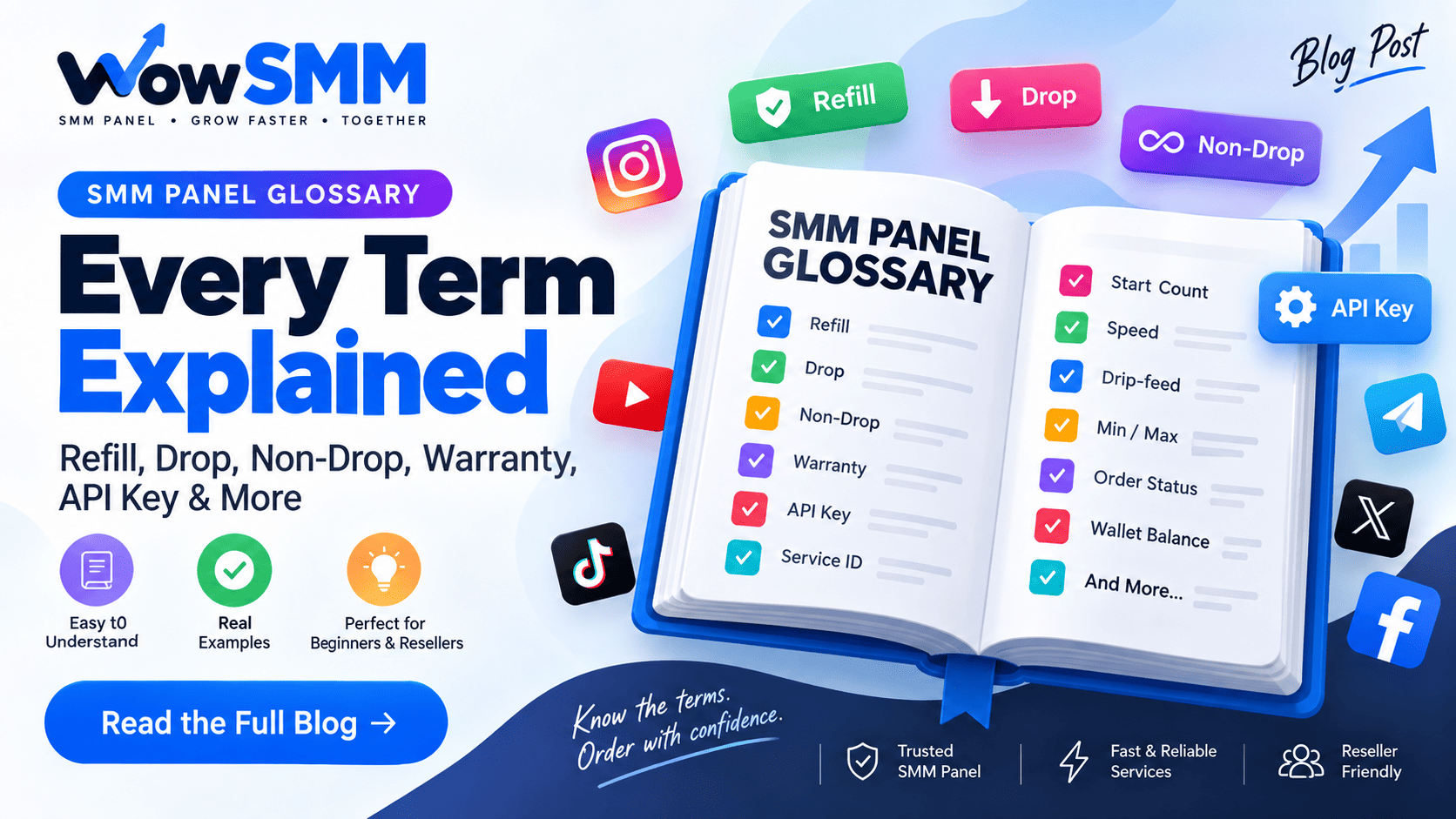
SMM Panel Glossary: Every Term Explained (Refill, Drop, Non-Drop, Warranty, API Key & More)

SMM Panel Glossary: Every Term Explained (Refill, Drop, Non-Drop, Warranty, API Key & More)

SMM Panel Glossary: Every Term Explained (Refill, Drop, Non-Drop, Warranty, API Key & More)

An SMM panel is a website where you buy social media engagement services (followers, likes, views, comments) in bulk at wholesale prices, usually through a dashboard or API. The rest of this glossary explains every term you'll run into while using one — refill, drop, non-drop, start count, warranty, speed, API key, service ID, and more — in plain language, with real examples from how orders actually behave.

Bookmark this page. Whether you're placing your first order or building a reseller business on top of an API, these are the exact words you'll see on every order page, every provider's service list, and every support ticket.

Core Order Terms

SMM Panel

A platform that resells social media marketing (SMM) services — Instagram followers, YouTube views, TikTok likes, Telegram members, and similar — sourced from upstream providers and sold to end users or resellers at a marked-up (but still low) price. Panels like WowSMM sit between the raw supply (providers who run the actual delivery infrastructure) and the customer placing an order.

Provider

The upstream source that actually fulfills an order — the infrastructure behind the scenes that delivers followers, likes, or views. A panel can work with one or several providers per service and switch between them if one becomes unreliable. As a customer you don't interact with providers directly; you only see the panel's storefront.

Service ID

Every service in a panel's catalog (for example "Instagram Followers – Real Looking – 30 Days Refill") has a unique numeric Service ID. You need this ID to place orders through the API — it's how the system knows exactly which service, price, and delivery method to use.

Rate (Rate per 1000 / Rate/1k)

The price for 1,000 units of a service. If a service is priced at ₹0.50 per 1000 and you order 5,000, the cost is ₹2.50. Panels quote rates per 1000 rather than per unit because most services are ordered in bulk (100s to millions of units).

Min / Max

The minimum and maximum quantity allowed per order for a given service. A service might have Min 100 / Max 50,000 — meaning you cannot order fewer than 100 or more than 50,000 in a single order. To go beyond the max, you place multiple orders.

Start Count

The follower/like/view count on your link at the moment the order begins processing, recorded automatically by the panel. Start Count matters because refill and drop calculations are based on the difference between Start Count and the current count — not on how many units you paid for.

Delivery & Speed Terms

Speed / Delivery Time

How fast an order completes once it starts — shown as an estimate like "10K/Day" or "Instant" or "Average Time: 2 hours." Speed varies by service, by provider capacity that day, and by how much demand the platform's own detection systems are absorbing at that moment; the same service can run faster or slower on different days even with identical settings.

Drip-feed

An option to spread delivery out over a longer period instead of all at once — for example, 1,000 followers delivered as 50/hour for 20 hours rather than all 1,000 in a few minutes. Drip-feed is generally used to make growth look more organic, which can matter for reducing scrutiny from a platform's spam-detection systems.

Mass Order / Bulk Order

A tool that lets you submit many orders at once (different links, services, or quantities) in a single batch — usually by pasting a list or uploading a file — instead of placing each order manually one at a time. Useful for agencies and resellers managing many client accounts.

Child Panel / Sub-panel / White-label Panel

A panel that resellers can create and brand as their own, running on top of a parent panel's inventory and pricing engine. The reseller sets their own retail prices and their customers never see the parent panel's name — they only see the reseller's branded site.

After the Order: Refill, Drop & Warranty

Drop

When followers, likes, or views you paid for disappear after delivery — the count goes down instead of staying where it landed. Some drop is normal and expected for cheaper, non-guaranteed services, because a portion of delivered engagement comes from accounts that platforms periodically detect and remove in their own cleanup cycles. Drop is measured against your Start Count, not against the exact number you ordered.

Non-Drop

A service marketed as "non-drop" claims the delivered engagement won't disappear, or will disappear far less than a standard service — typically because it uses higher-quality accounts that are less likely to be caught in platform sweeps. No provider can honestly promise zero drop forever; "non-drop" is a quality tier and a refill commitment, not a guarantee that is literally unbreakable.

Refill

A free top-up a panel provides if your count drops below what was delivered, within a defined refill window. Refill is calculated as Start Count + quantity ordered = expected End Count. If your current count is lower than the expected End Count, the difference can be refilled. Refill applies to the specific order and link combination — not to the account in general — so changing your username or switching an account to private usually voids refill eligibility for that order.

Refill Window / Warranty Period

The length of time refill coverage lasts after delivery — common windows are 30 days, 60 days, 90 days, 365 days, or "Lifetime." A longer refill window generally costs more because the panel is committing to monitor and top up that order for longer. Once the window expires, no further refill is provided even if the count drops afterward.

Cancel Button / Cancel Enabled

Some services allow you to cancel an order while it's still in progress and get a refund for the undelivered portion. A service marked "Cancel Enabled" supports this; one marked "No Cancel" will run to completion (or to whatever point the provider stops) without a partial-cancellation refund option.

Order Status Terms

Pending

The order has been placed and paid for but processing hasn't started yet — usually because it's queued behind other orders for the same service.

In Progress

Delivery has started and units are being added toward your link.

Partial

The order stopped before reaching the full quantity, and you're refunded for the undelivered portion. A partial often happens when the link becomes invalid mid-delivery (post deleted, account switched to private) or the provider's supply runs out for that batch.

Completed

The full ordered quantity was delivered. Note: an order can still show "Completed" even if the link was private or invalid when checked — in that case no refund applies, since the system recorded the delivery attempt as fulfilled.

Canceled

The order did not run and was refunded in full, typically because the link submitted was invalid, broken, or unsupported from the start.

Account & API Terms

Wallet Balance

Prepaid funds held in your panel account, used to pay for orders. On most panels — including WowSMM — wallet funds can only be spent on services within the panel and cannot be withdrawn to a bank account.

API Key

A private access token that lets external software (your own website, a script, or a reseller platform) place orders, check status, request refills, and check balance programmatically instead of through the panel's dashboard. See the API documentation for the exact endpoints and parameters.

Public vs. Private Service

A public service appears in the panel's regular catalog for anyone to order. A private service is hidden from the general catalog and only orderable by specific accounts or child panels — often used for testing new services or offering special pricing to select resellers.

R# / "Real-looking" Accounts

Shorthand some providers use to describe engagement from accounts with profile pictures, posts, and follower histories that resemble genuine users, as opposed to bare, obviously-fake accounts. "Real-looking" describes account quality, not verified authenticity — it's a durability signal correlated with lower drop rates, not a guarantee.

Frequently Asked Questions

What's the difference between drop and refill?

Drop is the problem (your count goes down). Refill is the solution (the panel tops it back up), but only within the refill window the service specifies and only for the same link.

Does refill cover unlimited drops forever?

No. Refill only covers drops within the stated window (e.g., 30 or 365 days) and stops once that window expires or once the order's refill eligibility is otherwise voided (private account, username change, etc.).

Why do speeds vary even for the same service?

Speed depends on provider capacity and platform conditions at that specific moment, not just the service's advertised average — the same service can run faster on a quiet day and slower during high-demand periods.

Is "non-drop" the same as "no refund"?

No — they're unrelated. Non-drop describes engagement quality/durability. Refund and cancellation policies are separate terms that depend on whether a service is "Cancel Enabled" and on the order's current status.

Do I need an API key to use a panel?

No — most users place orders through the dashboard. An API key is only needed if you're integrating a panel into your own website or automating orders through a script or reseller platform.

Have a term you don't see here? Check our FAQ page or reach out via Telegram — support is available 24/7.

Read More SMM Panel Glossary: Every Term Explained (Refill, Drop, Non-Drop, Warranty, API Key & More)

SMM Panel 2026 🌐 | Best SMM Panel for Social Media Growth

SMM Panel 2026 🌐 | Best SMM Panel for Social Media Growth

SMM Panel 2026 🌐 | Best SMM Panel for Social Media Growth

Social media continues to play a major role in digital marketing in 2026. Creators, influencers, businesses, agencies, and resellers are constantly looking for reliable ways to improve their online presence. An SMM panel provides a convenient platform where users can access different social media marketing services from one place.

Want to try this on a live panel? Start with the best SMM panel at WowSMM and pay with UPI, Binance or crypto.

WowSMM.com provides a wide range of social media marketing services designed for users who want to manage and scale their social media presence efficiently. From Instagram and YouTube to TikTok, Telegram, Facebook, and other major platforms, users can manage their campaigns through a single SMM panel.

Read More SMM Panel 2026 🌐 | Best SMM Panel for Social Media Growth
🔍No articles found. Try a different keyword.

Ready to grow your social media?

Fast, affordable services with refill support — start with any budget.

Explore more

Browse WowSMM Guides

Find guides, services and country pages in one place.

DMCA.com Protection Status